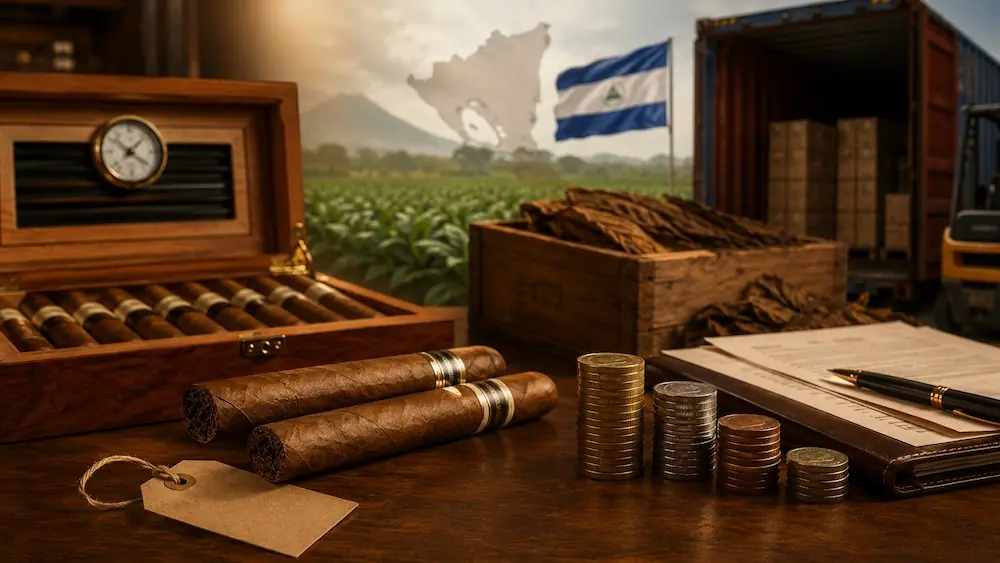
If you’ve noticed that some of your go-to cigars cost a little more lately, there’s a good chance tariffs are part of the story. Oliva raised prices twice in under a year, a 5 percent hike in 2025 followed by a 4 percent increase effective February 1, 2026, and both were tied directly to tariff pressure on Nicaragua. But this isn’t really a story about one company. It’s a story about how what happens in Washington eventually reaches the humidor.
- Tariffs on Nicaraguan goods pushed up the cost of bringing cigars into the United States, and those costs travel down the supply chain until they land with the smoker. Oliva is the most visible example, having raised prices twice in response to tariff pressure.
- Nicaragua supplies nearly 60 percent of all premium cigars imported into the United States, which means tariff pressure there is felt almost everywhere in the market, not just by one brand or one factory.
- The tariff situation has been volatile and is still moving. What matters for smokers is understanding the mechanism: tariffs amplify through the supply chain, so the final shelf-price impact is usually larger than the original tariff percentage suggests.
You see it on the shelf. You notice it in the box price. You feel it when a cigar that was an easy everyday pickup suddenly becomes something you think twice about.
WHY NICARAGUA IS AT THE CENTER OF THIS CONVERSATION
Nicaragua isn’t some fringe producer. It’s the single largest source of handmade premium cigars in the United States, accounting for roughly 58.8 percent of all imports, about 253 million cigars in 2024 alone. The country’s cigar industry grew dramatically over the past decade and now dwarfs even Cuba in sheer production volume.
Padrón, Oliva, Drew Estate, A.J. Fernandez, and Perdomo all make their entire lines there. Rocky Patel, My Father, J.C. Newman, Plasencia, and General Cigar all have significant Nicaraguan factory presence too.
That dominance is exactly why tariff pressure on Nicaragua lands so hard across the market. When import costs rise for Nicaraguan goods, it isn’t a single company dealing with a contained problem. It’s most of the premium cigar business absorbing a higher cost structure at the same time.
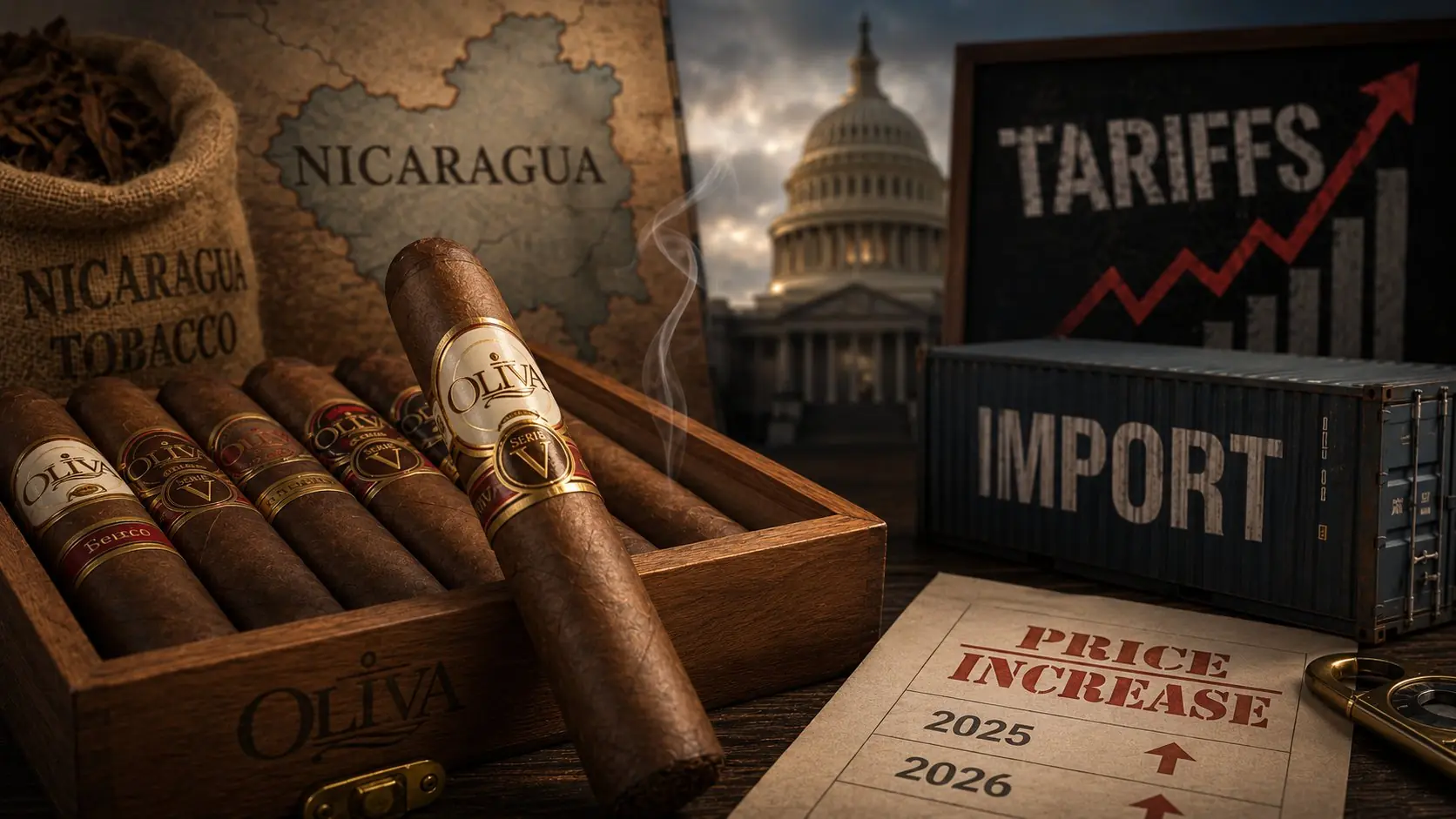
The tariff situation was never simple or static. In April 2025, the Trump administration announced a baseline 10 percent tariff on most countries, with Nicaragua initially set at 18 percent. A 90-day pause brought Nicaragua briefly back to 10 percent, then the rate went back up when the pause ran out. Through early 2026 the pressure on Nicaraguan goods stayed meaningfully higher than pre-2025 levels, and prices moved to match.
WHY OLIVA BECAME THE EXAMPLE EVERY SMOKER HEARD ABOUT
Oliva became the headline because the company was transparent about what was happening and why. The first increase, 5 percent in the summer of 2025, was tied directly to the initial tariff rate on Nicaraguan goods. The second, 4 percent effective February 2026, came after rates rose again.
Two rounds of increases in less than a year isn’t something a company does quietly. It put the issue in front of smokers in the most practical way possible: a higher box price on a line millions of people buy regularly.
Oliva isn’t the only brand feeling this, it’s simply the most visible one because it made the connection explicit. Any brand that manufactures in Nicaragua, or sources significant tobacco from there, was dealing with the same underlying cost reality. Some companies raised prices directly. Others adjusted margins, tightened release schedules, or made subtler moves.
HOW A TARIFF ACTUALLY REACHES YOUR WALLET
One of the most common misunderstandings about tariffs is that the stated percentage maps directly to what you pay. It doesn’t work that way. A tariff doesn’t hit the shelf price, it hits the import cost, and every layer of the supply chain builds margin on top of that new higher base.
For most handmade premium cigars, that import cost runs somewhere between $2 and $4 per cigar, and the tariff is charged on that figure. From there the importer, the distributor, and the retailer each add margin to the new, higher landed cost. The math compounds quietly, then it shows up all at once.
When the tariffs first hit, industry estimates put the consumer cost anywhere from 50 cents to $2.10 per cigar, depending on the import price, the supply chain, and your state’s tobacco taxes. In states where the excise tax is calculated as a percentage of wholesale, the tax stacks on top of the already-inflated cost. So take a 40-cent tariff at the import level, call it an extra dollar and change by the time it hits the shelf.
WHAT SMOKERS SHOULD KNOW ABOUT TARIFF MATH
- Tariffs aren’t charged on the retail price. They’re assessed on the import cost, typically $2 to $4 per handmade premium cigar. The shelf-price impact is always larger than the tariff percentage alone suggests.
- Every margin layer multiplies the cost. Importer, distributor, and retailer each add margin on top of the new higher base. A small tariff at the import level becomes a larger increase by the time it reaches the consumer.
- Tobacco taxes can compound the problem. In states where excise tax is calculated as a percentage of wholesale price, higher wholesale prices mean higher tax bills at the state level too.
- Rates change, the math doesn’t. Tariff rates on Nicaraguan goods changed multiple times between April 2025 and early 2026. What matters is understanding the mechanism, not memorizing a specific percentage.
WHO FEELS THIS, AND HOW
Smokers
Smokers feel this story the most directly. It hits the wallet. An easy everyday cigar can become a once-in-a-while cigar.
But there’s a second layer beyond the price: variety. If trade pressure keeps narrowing the financial runway for smaller producers, the market becomes less adventurous over time, boutique brands find it harder to compete. The result isn’t just a more expensive humidor, it can become a less interesting one.
Retailers
Retailers are caught in the middle in ways that are easy to underestimate. They didn’t create the tariff and have no control over import costs, but they’re the ones standing at the register explaining why the same product now costs more. They also have to make real buying decisions: which cigars still make financial sense to stock, which boutique lines still offer enough margin to justify shelf space, and which brands to lean on when the economics of discovery start to feel too risky.
Boutique Brands
Smaller boutique operations are typically the most exposed in a cost-pressure environment. They don’t have the production scale or distribution muscle that larger companies use to absorb or negotiate around higher import costs. When the numbers stop working, boutique brands are often the first to pull back a release, reduce a blend size, or step back from a market entirely. That’s how variety quietly disappears.
THE 2025 SNAPSHOT: TARIFF EXPOSURE BY COUNTRY
The table below is the 2025 picture, the initial round of tariff actions that set this whole story in motion. These rates are no longer current, the flat 10 percent surcharge described in the update note replaced them in February 2026. Keep it as the historical record of where each country started.
| COUNTRY | INITIAL 2025 TARIFF RATE (SINCE SUPERSEDED) | WHAT IT MEANT IN PRACTICE |
|---|---|---|
| Nicaragua | 18% (initial 2025 rate) | The heaviest tariff burden of the 2025 round. Home to Padrón, Oliva, Drew Estate, A.J. Fernandez, Perdomo, and many others. |
| Dominican Republic | 10% (initial 2025 rate) | Also affected, but at a lower initial rate than Nicaragua. Larger brands with Dominican production had somewhat more cushion to absorb costs. |
| Honduras | 10% (initial 2025 rate) | Same initial tier as the Dominican Republic. Honduras attracted interest as an alternative production base for companies looking to diversify away from Nicaragua’s higher tariff exposure. |
| Ecuador | 10% (initial 2025 rate on cigar imports) | Ecuador matters not just for cigars but for wrapper tobacco used across blends worldwide. Even moderate tariff pressure on Ecuadorian leaf ripples into premium blends from multiple countries. |
WHERE THIS STORY GOES FROM HERE
Nobody should assume this is the last pricing story tied to trade policy. The tariff environment that hit the cigar world starting in April 2025 was anything but settled, rates moved, pauses were announced and expired, and threats of far more severe increases were made and walked back. The courts eventually stepped in, and the update note at the top of this page tells you where things stand now.
What that volatility already produced is a shift in how some companies think about production geography. The Garcia family, makers of My Father Cigars, opened operations in Honduras as the tariff threat against Nicaragua intensified. Other producers explored similar moves, or at minimum weighed their options in case Nicaraguan rates climbed substantially higher.
For the smoker paying attention, the bigger story may not be the next price increase. It may be the slow reshaping of where cigars are made, how supply chains get rebuilt, and which countries emerge as growth markets over the next decade. All of it traces back, at least in part, to what started with tariff policy in 2025. The prices moved first. The map moves next.
FREQUENTLY ASKED QUESTIONS
Common questions about tariffs, Nicaraguan cigars, and what it all means at the shelf.